
What to bring to a migraine doctor appointment
Appointments are short, and it’s hard to remember a month of headaches on the spot. Bring a one-page summary: headache days per month, how long attacks last and how bad they are, your symptoms, your medicines and how many days you took them, and what helped.
Short answer: bring 1–3 months of diary data summarised on one page — headache days per month, attacks, typical duration and intensity, main symptoms, likely triggers, every medicine with the number of days used and how well it worked — plus a short list of your questions.
The numbers doctors ask for
| Question | What to bring |
|---|---|
| How often? | Headache days per month, for each of the last 1–3 months |
| How long? | Typical attack length and the longest attack |
| How bad? | Average intensity and how many attacks stop you working or doing normal things |
| What happens? | Aura, nausea or vomiting, light and sound sensitivity, one-sided pain |
| What do you take? | Every acute medicine, dose, number of days per month, and how often it helps |
| Anything preventive? | Current and past preventive treatments, how long you tried them and why you stopped |
| Patterns? | Likely triggers, time of day, link to your menstrual cycle, weather |
Headache days and medicine days carry the most weight. They help your doctor see whether migraine is episodic or chronic (see how to count headache days) and whether medication overuse could be making things worse (see medication overuse headache).
A one-page report template
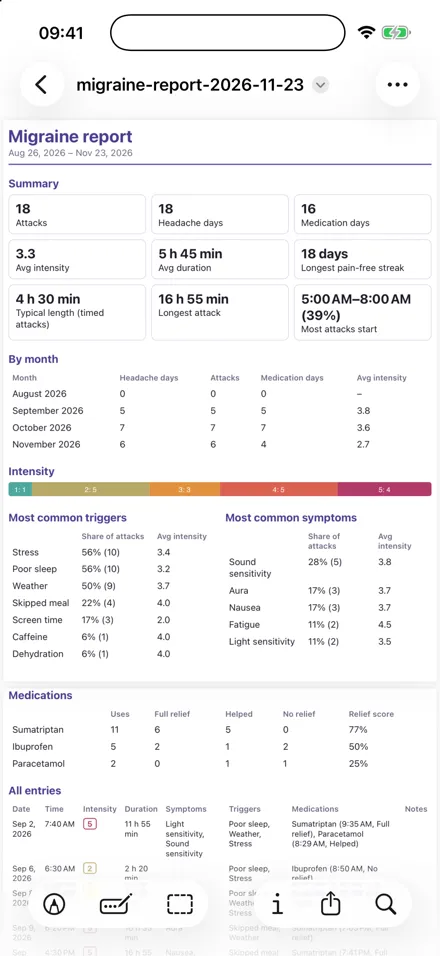
- Period covered — for example the last 90 days.
- Summary — attacks, headache days, medicine days, average intensity, longest pain-free stretch.
- By month — a small table of headache days, attacks and medicine days per month.
- Intensity mix — how many attacks were mild, moderate, severe.
- Most common symptoms and triggers — with the share of attacks.
- Medicines — uses and how often each one helped.
- Notes — anything new or unusual.
Questions worth preparing
- Is this migraine, or could it be another type of headache?
- Is my acute medicine the right one, and am I taking it at the right time?
- Am I taking acute medicine on too many days?
- Should I consider preventive treatment? What are the options?
- What should I track before our next appointment?
Warning signs not to wait on
Don’t wait for a routine appointment if you have a sudden, severe “worst ever” headache, a headache with fever and stiff neck, weakness, confusion, trouble speaking, or a headache after a head injury. Get urgent medical help.
Making the report with Migraine Tracker
Migraine Tracker creates a doctor report as a PDF from your journal — the last 90 days by default. It includes a summary, a month-by-month table of headache days, attacks and medicine days, the intensity mix, the most common triggers and symptoms, medicines with their relief score, and all entries. If your medicine days are close to overuse limits, the report says so.
This guide is general information, not medical advice. If your headaches change, get worse, or come with new symptoms, see a doctor.