
Barometric pressure and migraines: is it the weather?
Many people with migraine say weather changes bring on their attacks, and falling barometric (air) pressure before a storm is the most common suspect. Research supports a link for some people but not for everyone — so the useful question isn’t “does weather cause migraines?” but “does it cause mine?”
Short answer: pressure drops seem to trigger migraines in a subset of people, while studies of larger groups show mixed results. To check for yourself, record the air pressure and how much it changed in the 24 hours before each attack, then compare how often attacks follow a drop versus other days.
What is a barometric pressure migraine?
It isn’t a separate diagnosis. “Barometric pressure migraine” or “weather migraine” is an everyday name for migraine attacks that seem to be set off by changes in the weather — most often a fall in air pressure as a low-pressure system or storm moves in. Other weather factors people report include high humidity, heat, strong winds and bright sun.
What the research says
The evidence is genuinely mixed:
- Surveys consistently find that a large share of people with migraine list weather as a trigger.
- Some studies that matched diaries to weather records found more attacks on days after pressure fell, at least in some of the people studied.
- Other studies found no clear link at the group level, or found that people who believed weather was a trigger weren’t always the ones whose attacks tracked the weather.
The likely explanation is that weather sensitivity is individual. Some people react strongly, many don’t at all, and in a mixed group the effect can wash out. That is why your own data is more useful than population averages.
Why might pressure changes matter?
No one knows for sure. Ideas include pressure differences affecting the sinuses or inner ear, and changes in the nervous system’s sensitivity as weather shifts. Weather also changes other things — sleep, mood, time spent indoors — which can act as triggers themselves.
How to test the weather link on yourself
- Record the pressure with each attack. Note the local air pressure in hPa (or inHg) when the attack starts.
- Record the change, not just the value. What matters most is usually how much the pressure fell or rose in the 24 hours before.
- Pick a threshold. Decide what counts as a “drop”, for example a fall of a few hPa in 24 hours, and stick to it.
- Compare with all days. Count how many attacks followed a drop, and how many days in the same period had a drop. If 40% of your attacks follow a drop but only 15% of days have one, that is a signal.
- Collect enough attacks. With only a handful of attacks, coincidences dominate. Wait for at least 10–15 before deciding.
If weather is one of your triggers
You can’t avoid the weather, but you can plan for it:
- Watch the forecast for big pressure drops and keep your acute medicine with you.
- Protect your other triggers on those days — sleep, meals, water, stress — since triggers tend to stack (see how to find your migraine triggers).
- Mention it to your doctor; it can help when timing treatment or judging whether a preventive is working through a stormy season.
Checking the weather link in Migraine Tracker
Turn on air pressure in Migraine Tracker and every attack saves the local pressure and whether it fell, rose or stayed steady in the 24 hours before. Once you have enough attacks with weather data, the Air pressure insight shows how many attacks started after a pressure drop and whether attacks are more common after drops than on other days.
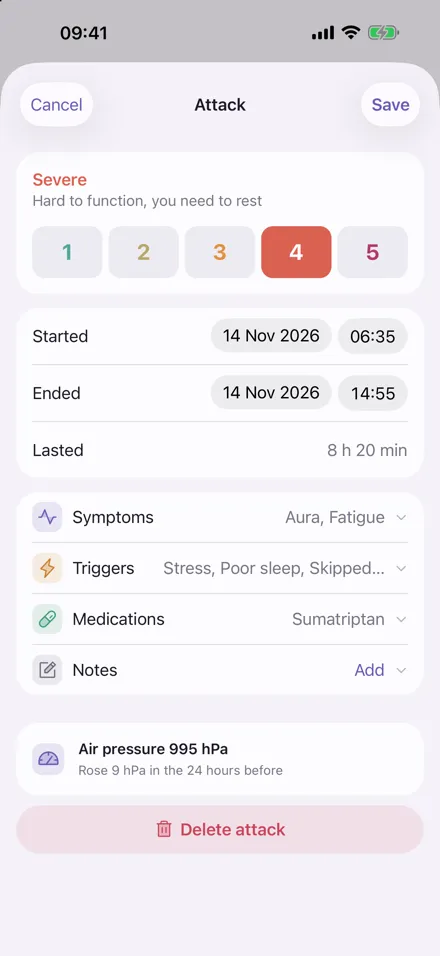
Pressure comes from Open-Meteo for an area of about 10 km around you. Only that rough area is sent, and it isn’t stored.
This guide is general information, not medical advice. If your headaches change, get worse, or come with new symptoms, see a doctor.