
How to keep a migraine diary (and actually stick with it)
A migraine diary is a record of every attack: when it started, how long it lasted, how bad it was, what might have set it off and what you took for it. Two or three months of entries are usually enough to show patterns you and your doctor can act on.
Short answer: for each attack, record the start and end time, intensity (1–5 or 0–10), symptoms, possible triggers from the last 24 hours, and each medicine with the dose time and whether it helped. Log the basics during the attack and fill in the rest once you feel better.
Why keep a migraine diary?
Memory is a poor witness for migraine. A bad week blurs into a bad month, and a quiet month makes it easy to forget how often you were in pain. A diary turns “I get a lot of headaches” into numbers: headache days per month, typical attack length, how often a medicine works.
Those numbers matter. Doctors use headache days to tell episodic from chronic migraine, to decide whether preventive treatment makes sense, and to judge whether a treatment is working. Many headache specialists ask new patients to keep a diary before or between appointments for exactly this reason.
What to record for every attack
| Field | What to write | Why it helps |
|---|---|---|
| Start time | Date and time, or at least morning / day / evening / night | Shows time-of-day and weekday patterns |
| End time or duration | When the pain was gone, or an estimate | Typical attack length; separates migraine from other headaches |
| Intensity | A number: 1–5 or 0–10. Keep the same scale | Lets you compare attacks and treatments |
| Symptoms | Aura, nausea, vomiting, light or sound sensitivity, one-sided pain | Helps your doctor confirm the headache type |
| Possible triggers | Sleep, stress, meals, alcohol, caffeine, weather, menstrual cycle, screens | The raw material for finding real triggers |
| Medicines | Name, time taken and whether it helped (fully, partly, not at all) | Shows what works and counts medicine days |
| Notes | Anything unusual: travel, a missed dose, a new food | Context you will not remember later |
A simple paper template
If you prefer paper, one line per attack is enough:
Date · Start – End · Intensity (1–5) · Symptoms · Triggers (last 24 h) · Medicine + time · Helped? (yes / partly / no) · Notes
Also mark days with no headache at all. Pain-free days matter: without them you can’t count headache days per month accurately.
How to keep it up on bad days
The hardest part of a migraine diary is filling it in while you’re in pain, in a dark room, maybe nauseous. These habits make it stick:
- Separate “log” from “details”. During an attack, record only the start time and intensity. Everything else can wait.
- Use the same scale every time. Write down what each number means for you once (for example 3 = can’t work, 5 = in bed) and stick to it.
- Fill in triggers the next day. You’ll judge sleep, stress and meals more honestly once the pain is gone.
- Rate medicines a couple of hours later. “Did it help?” is easier to answer once the dose has had time to work.
- Set one gentle reminder. An evening check-in catches attacks you forgot to log.
- Don’t chase perfection. An entry with only a date and intensity is still useful. Missing entries hurt your data more than incomplete ones.
How long should you keep a diary?
Aim for at least two to three months before drawing conclusions about triggers or treatments. Migraine varies a lot from month to month, and hormonal or seasonal patterns only show up over several cycles. If you’re starting a new preventive treatment, keep logging for the whole trial period so you can compare before and after.
Reading your diary
Once you have a few months of entries, look for:
- Headache days per month — the single most useful number for your doctor (see how to count headache days).
- Medicine days per month — to watch for medication overuse.
- Triggers that keep coming back — see how to find your triggers.
- Timing — weekends, mornings, around your period, after travel.
- Which medicine works and how often.
Keeping a migraine diary in Migraine Tracker
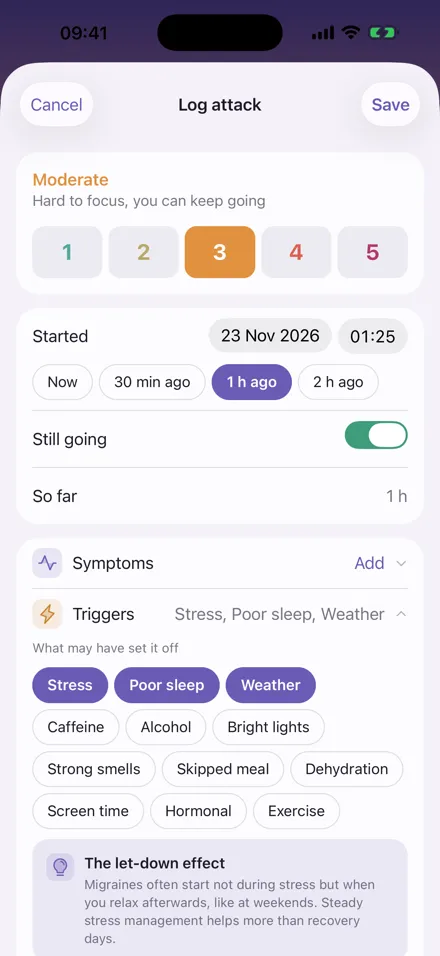
Migraine Tracker is built around the “log now, details later” habit. One tap starts an attack with a live timer on your Lock Screen; ending it gives you an exact duration. Symptoms, triggers and medicines are chips you can add when you feel better, and the app asks “Did it help?” about medicines you haven’t rated yet.
The month calendar colours each day by intensity, and insights count headache days, medicine days and your most common triggers for you. Everything stays on your device.
This guide is general information, not medical advice. If your headaches change, get worse, or come with new symptoms, see a doctor.