How to find your migraine triggers
To find your migraine triggers, log every possible trigger with every attack for a few months, then look for the ones that show up again and again — and that show up more before attacks than on ordinary days. One bad night’s sleep before one attack proves nothing; the same pattern ten times does.
Short answer: track sleep, stress, meals, drinks, hormones and weather with every attack for 2–3 months. Count how often each trigger appears. Treat a trigger as likely only when it appears in a large share of attacks, when it tends to come with worse attacks, and when it isn’t just something that happens most days anyway.
Common migraine triggers
Triggers differ a lot between people, and many people never find a single clear one. These are the ones reported most often:
- Stress — and also the let-down after stress (weekend or holiday migraines).
- Sleep changes — too little, too much, or a different schedule.
- Skipped or late meals and dehydration.
- Hormonal changes — especially around menstruation.
- Alcohol, particularly red wine for some people.
- Caffeine — both too much and withdrawal.
- Weather changes, such as falling air pressure (see barometric pressure and migraines).
- Sensory triggers — bright or flickering light, loud noise, strong smells, long screen time.
- Certain foods — aged cheese, processed meats or others, though food triggers are less common than people expect.
Why triggers are hard to spot
Three things make triggers tricky:
- Triggers often stack. Poor sleep alone may be fine; poor sleep plus a skipped lunch plus stress may not be.
- Early symptoms look like triggers. In the hours before the headache (the prodrome), many people crave sweets, yawn or feel sensitive to light. Eating chocolate may be an early sign of the attack, not its cause.
- Common things look guilty. If you drink coffee every day, coffee will appear before every attack — that alone doesn’t make it a trigger.
A step-by-step method
1. Pick a short trigger list
Choose 6–10 candidates you suspect, plus a few common ones. A short list you fill in every time beats a long list you abandon.
2. Log with every attack, for 2–3 months
For each attack, tick which triggers happened in the 24 hours before. If you can, note the same things on a few headache-free days each week — that gives you a baseline.
3. Count
For each trigger, work out the share of attacks it appeared in. For example: stress in 8 of 15 attacks (53%), poor sleep in 8 of 15, weather in 7 of 15.
4. Compare with normal days
A trigger is more convincing if it’s clearly more common before attacks than on ordinary days. Poor sleep before 53% of attacks means more if you sleep badly on only 15% of nights.
5. Check severity
Look at the average intensity of attacks with each trigger. Some triggers come with your worst attacks even if they aren’t the most frequent.
6. Test carefully
For a likely trigger you can control — a regular sleep schedule, not skipping breakfast — change one thing for a month and keep logging. Changing everything at once makes it impossible to tell what helped. Don’t cut out whole food groups without talking to a doctor or dietitian.
What to do with what you find
Some triggers can be avoided (skipped meals, a specific drink). Others can’t (weather, hormones) but are still useful to know: they help you plan, keep medicine with you, and explain to your doctor why attacks cluster at certain times.
Finding triggers with Migraine Tracker
In Migraine Tracker you tag triggers as chips on each attack — stress, poor sleep, weather, skipped meals, caffeine, alcohol, screen time and more, or your own with Premium. The Triggers insight ranks them by the share of attacks they appear in, shows the average intensity of those attacks, and sums it up in one line, such as “Stress comes up in 53% of your attacks.”
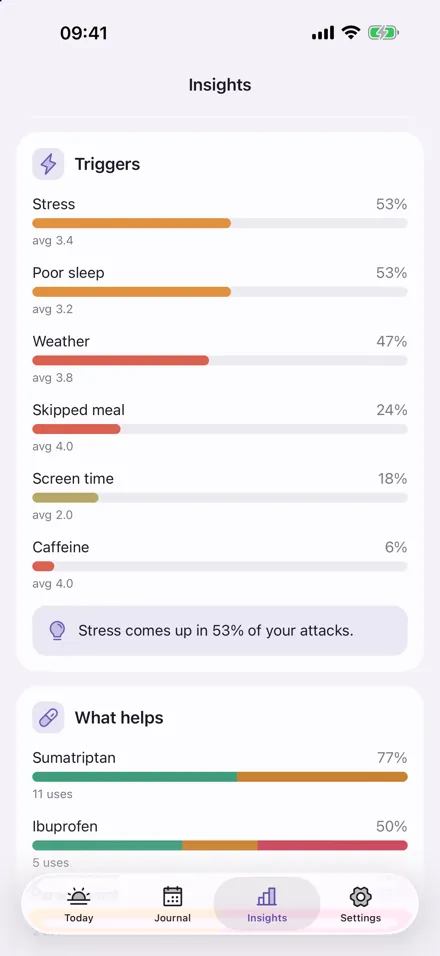
With air pressure turned on, the app also checks whether your attacks are more common after a pressure drop than on other days — a built-in version of step 4 for weather.
This guide is general information, not medical advice. If your headaches change, get worse, or come with new symptoms, see a doctor.